Live Laugh Love Daisy: A Designer’s Stitch Test
As an embroidery designer who has digitized and tested thousands of files, I approach the "Live Laugh Love" phrase with a healthy dose of skepticism. It is arguably the most ubiquitous saying in home decor, which means it can easily feel dated or generic. However, when evaluating the Live Laugh Love Daisy machine embroidery design, my perspective shifts from critiquing the cliché to assessing the execution. This specific iteration uses botanical elements to soften the typography, transforming a standard family quote into something that feels fresher and more aligned with current cottagecore and modern farmhouse aesthetics. For small business owners and Etsy sellers, this distinction matters because it changes the perceived value of the finished product.
First Impressions and Visual Balance
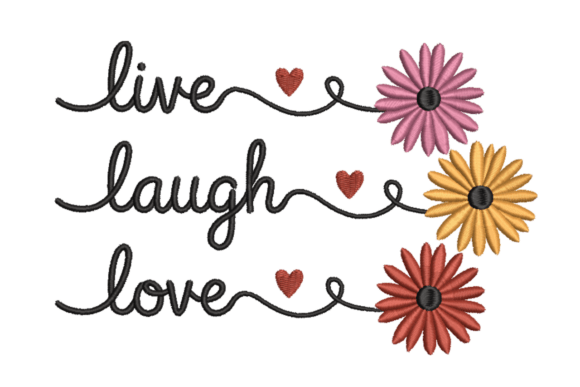
My initial assessment of this embroidery file focuses on layout and negative space. Unlike blocky, text-heavy designs that can look like a sticker once stitched, the Live Laugh Love Daisy integrates organic curves with structured lettering. The daisy motif acts as a visual anchor, breaking up the horizontal lines of text and adding necessary texture. From a design asset standpoint, this balance is crucial. When you are creating printable mockups for your shop or planning a new collection, the eye needs somewhere to rest. The floral element provides that relief, making the design feel less like a slogan and more like an illustration.
The mood here is undeniably cheerful but restrained. It avoids the chaotic density of some vintage-style floral designs while maintaining enough detail to justify its placement on premium handmade products. For those of us in the craft business, this versatility is key. It reads well as both a nursery accent and a kitchen textile, bridging the gap between baby embroidery and general home decor without requiring separate inventory.
Real-World Application: The Tea Towel Test
To truly evaluate this design, I mentally placed it in a real production scenario rather than just viewing it on a screen. Let’s consider a custom embroidered tea towel project intended for holiday gifts or boutique merchandise. Tea towels are typically made of linen or cotton twill, fabrics that have distinct weave textures. A design with too much fill stitch density will cause puckering on these materials, while one with too little coverage will get lost in the fabric grain.
In this context, the Live Laugh Love Daisy performs admirably because of its mixed media approach. If the design utilizes satin stitch for the stems and petals alongside lighter running stitch or redwork details for the text, it allows the fabric to breathe. This is vital for maintaining the drape of the towel. When stitching this out, I would pay close attention to the transition points between the flower and the letters. In a real-life test run, ensuring the thread colors complement rather than clash with the natural linen background elevated the final piece from "craft fair basic" to "boutique quality." Customers respond to this level of intentionality; they trust a handmade product where the embroidery looks like it belongs on the fabric, not just sitting on top of it.
Navigating Fabric Challenges and Stabilizer Choices
While the design is versatile, there are specific scenarios where caution is required. As experienced makers know, not all surfaces forgive poor stabilization. If you plan to use this design for sweatshirt embroidery or custom apparel, you must account for stretch. Knit fabrics are unforgiving with dense satin stitches. Before committing to a bulk order of crewnecks, verify the stitch density of the file. If the daisy centers are overly dense, consider using an applique design variation if available, or switch to a cutaway stabilizer to prevent distortion.
Textured fabrics like terry cloth or fleece present another hurdle. The delicate details of the daisy petals can sink into high-pile fabrics, rendering them invisible after washing. For these applications, I strongly recommend testing the design on scrap fabric first. You may need to add a water-soluble topping to keep the stitches crisp. Conversely, on thin fabrics like voile or lightweight cotton for baby clothes, the concern shifts to durability. Heavy fill stitches can tear through delicate weaves. Always match your hoop size and stabilizer weight to the specific garment, not just the design dimensions. A 4x4 hoop might technically fit the file, but hooping a larger area with appropriate tension often yields better registration for complex layouts like this.
Commercial Viability and Customer Perception
For Etsy sellers and creative entrepreneurs, the question isn't just "does it stitch well?" but "will it sell?" The Live Laugh Love Daisy occupies a sweet spot in the market. While the phrase is common, the botanical styling updates it for buyers who want sentiment without kitsch. When listing this as part of a commercial embroidery project or selling finished goods, photography plays a massive role. Because the design relies on the interplay of thread sheen and fabric texture, flat-lay photos often fail to capture its depth. I advise taking angled shots that show the dimensionality of the satin stitches against the matte fabric.
Furthermore, consider the licensing of your digital embroidery file. Before offering personalized gifts or mass-producing tote bags, confirm whether your purchase includes commercial rights for physical products versus digital redistribution. Many designers allow you to sell the stitched-out item but prohibit sharing the file itself. Clarifying this protects your business and respects the original digitizer. When marketing this design, emphasize the craftsmanship. Highlight that it is professionally stabilized and color-tested. Buyers are increasingly savvy; they can distinguish between a hastily stitched patch and a carefully executed piece of fiber art. Using terms like "heirloom quality" or "botanical embroidery" in your listings can help differentiate your work from mass-produced alternatives.
Designer Notes for Optimal Results
Based on my evaluation, here are practical steps to ensure success with this design:
- Contrast Check: Always test thread colors against your specific fabric batch. White thread on cream fabric requires different shading than white on navy. Use black and white mockups to check value contrast before threading your machine.
- Detail Inspection: Zoom in on the smallest text elements in your embroidery software. If the letters are under 4mm tall, they may require a font swap or simplification to remain legible after washing.
- Stabilizer Strategy: For woven fabrics, use a tear-away backing with spray adhesive. For knits and stretchy apparel, a permanent cutaway is non-negotiable to maintain shape integrity.
- Mockup Testing: Create digital previews showing the design on multiple product types—a cap, a pillow cover, and an apron. This helps visualize scale and placement before you waste consumables.
- Wash Testing: If this is for baby items or kitchen textiles, wash and dry your test swatch three times. Inspect for thread shrinkage, bobbin show-through, or fabric tunneling. Real-world durability builds customer trust.
Ultimately, the Live Laugh Love Daisy succeeds because it treats a familiar concept with fresh artistic respect. It offers makers a reliable, aesthetically pleasing option that translates well across various mediums. Whether you are creating a personalized gift for a client or stocking your own shop for the holiday season, approaching this design with technical mindfulness ensures the final result honors both the sentiment and the craft. By prioritizing proper stabilization, fabric compatibility, and thoughtful presentation, you transform a simple digital file into a tangible expression of quality that resonates with today’s discerning buyers.